Failed Your Air Force PT Test? Here's What Happens Next
A failed Air Force PT test triggers specific administrative consequences under DAFMAN 36-2905. Here is exactly what happens, what FIP enrollment means, and how to recover.
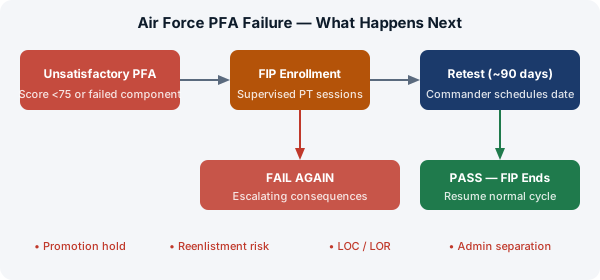
A score below 75, or a missed component minimum, is officially recorded as an Unsatisfactory Fitness Assessment (UFA). That label kicks off a defined sequence of events under DAFMAN 36-2905, and understanding each step matters more than you might think right now.
Here's what the next 30, 60, and 90 days look like, what it means for your career, and how to get back on track.
What "Unsatisfactory" Officially Means
An Unsatisfactory result happens under one of two conditions: your composite score is below 75, or you score below the minimum in at least one component, even if your total composite hits 75 or higher.
Component minimums exist separately from the composite. For a male Airman in the 25–29 age group, the push-up minimum is 33 reps, worth roughly 11 points. Sit-up minimums follow a similar pattern. The run minimum for that same demographic requires finishing the 1.5-mile in under 18:11. Fall short of any single component minimum and the assessment is Unsatisfactory regardless of your other numbers. You can run a sub-9-minute 1.5-mile and still fail if your push-up count misses the floor.
A score of 74.9 and a score of 55 are both Unsatisfactory. Administratively, they're treated identically, though commanders have discretion in tone and approach.
FIP Enrollment: What It Is and What It Requires
The Fitness Improvement Program is not optional. After a UFA, your unit fitness program manager (UFPM) enrolls you within a defined window. FIP typically runs for at least 90 days, tied to your retest date, and requires supervised fitness sessions at least 3 days per week.
Those sessions are structured around your weak components, documented, and your attendance is tracked. Missing sessions without a legitimate excuse gives your commander additional grounds for administrative action. That's a separate problem you don't want stacked on top of the original one.
What FIP is not: punishment. It's a structured training intervention. Airmen who treat those sessions as free coaching, rather than mandatory check-ins, consistently do better on their retests than those who show up passively. The consistency FIP forces is often what was missing in the first place.
Retesting Timeline
Under DAFMAN 36-2905, retesting happens no earlier than 90 days from the date of failure. Some units schedule the retest at day 90; others wait until closer to the next annual assessment window. Your UFPM sets the specific date.
You can't voluntarily test earlier than that 90-day minimum. The window exists to allow genuine fitness improvement, not to give someone a chance to retest after a recovered bad day.
If you're within striking distance of a passing score, run your current practice numbers through the USAF PT score calculator before your retest. Knowing you're sitting at 73 composite with one component just under minimum tells you exactly where 2 to 3 weeks of targeted work should go, rather than splitting effort across all three components.
Career Consequences
Promotions and Performance Reports
A UFA appears in your Enlisted Performance Report (EPR). One UFA in a reporting period will typically lower the overall rating, and lower EPR ratings affect promotion board standing. For officers, the same logic applies to OPRs. A UFA can result in a referral report, which carries significant career weight.
Promotions to E-5 and above require a current passing fitness assessment. A UFA doesn't automatically pull someone from a promotion list, but boards see the full EPR record. A documented fitness failure is visible.
Reenlistment
An Airman with an open UFA, still in FIP or with a second UFA, may face reenlistment denial or delay. Selective reenlistment bonus eligibility can also be affected. Commanders have discretion, but there's no AFSC where repeated fitness failures are treated as neutral.
Special Duty and Clearances
Assignments requiring security clearances or special duty qualifications can be affected by ongoing fitness issues depending on specific circumstances. A single UFA probably won't disqualify you. A pattern becomes harder to explain.
Multiple Failures: How It Escalates
The regulation is clear about what happens as failures stack up within a 24-month window:
- Second UFA in 24 months: commander initiates a referral EPR and formal counseling.
- Third UFA in 24 months: unit commander may initiate administrative separation proceedings.
Administrative separation is not automatic after three failures. Commanders have latitude, but the authority is real and it's applied. It's typically processed under the appropriate enlisted or officer separation instruction. The separation code affects future federal employment, VA benefits eligibility, and other long-term considerations.
One failure is recoverable. Two is serious. Three puts the career at genuine risk. The 24-month window is what matters: three failures spread over 5 years is a different situation than three failures in 18 months.
What Commanders Can and Can't Do
Commanders have real authority here, bounded by the regulation.
They can: Require FIP attendance, place a UFA in your record, factor fitness status into performance reports, delay reenlistment actions, recommend administrative separation after repeated failures, restrict leave during active FIP periods to ensure session attendance.
They can't: Administer UCMJ action based solely on a single PT failure (it's administrative, not criminal), require retesting before the 90-day window, retroactively waive component minimums, or withhold pay or strip rank without formal legal process.
If you believe your test was administered incorrectly (a timing error on the run, a form call on push-ups that doesn't match the standard), document it and raise it through your chain of command immediately. The window for disputing test administration closes fast.
The Mental Side of Recovery
A lot of Airmen describe the period right after a UFA as demoralizing. The embarrassment in front of peers, the anxiety about career impact, the background stress that makes training feel harder. Those are real and normal.
The practical answer: get specific fast. Not "I need to get better at the run" but "I need to drop 90 seconds off my 1.5-mile time, which means 3 threshold intervals per week for the next 10 weeks." Specific problems have specific solutions. Vague goals have vague results.
Talk to the fitness center staff. Most installations have strength and conditioning coaches whose job is exactly this situation. A targeted FIP plan beats general gym time.
A Practical 90-Day Recovery Path
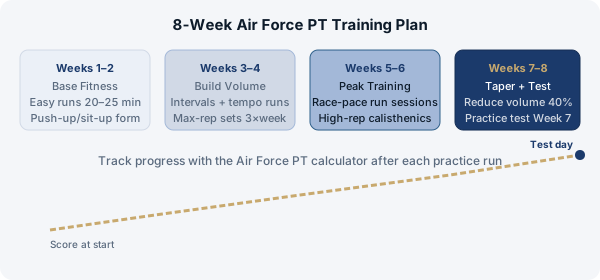
Days 1–30 (Base): Consistency over intensity. Run 4 days per week at a conversational pace, 20 to 30 minutes. Do push-up and sit-up volume work twice per week using submaximal sets. Let adaptation happen.
Days 31–60 (Build): Add interval work on 2 of your 4 run days. A simple starting format: 6 × 400 meters at slightly faster than goal 1.5-mile pace with 90-second rest intervals. Increase calisthenics to 3 days per week. Start timing your push-up and sit-up sets to match test conditions.
Days 61–90 (Peak and Taper): Reduce run volume by 20% in week 11. Do one full practice test at day 80, all components in sequence, test conditions. Plug those results into the Air Force fitness assessment tool to see your projected composite. Taper the final 4 days: no hard training, good sleep, solid nutrition.
Know your specific targets. A male Airman aged 25–29 who needs exactly a 75 composite needs approximately 33 push-ups (minimum, 11 pts), 42 sit-ups (13 pts), and a 1.5-mile finish around 13:36 (51 pts). That's 75. But targeting the minimum leaves zero margin for a bad rep count or a slow morning. Aim for 85.
Tracking Progress Through FIP
Every 2–3 weeks during FIP, run a practice session and plug the numbers into the AFPT score tracker to see your projected composite. Watching it move, even 2 or 3 points, confirms the training is working.
It also flags when you've fixed one problem and created another. Some Airmen train the run so aggressively they arrive at the retest with 8 more run points but 4 fewer push-up points. The composite doesn't care where the points come from.
For a structured approach to moving your score before the retest, read the 8-week improvement plan. If a medical condition affected your test or is affecting your FIP training, understand how profiles and exemptions change your scoring before your next assessment.
For information on how our scoring reflects the current DAFMAN 36-2905 standards, see the about page.
One failed test is a data point, not a verdict. The regulation gives you a clear path back. Take it seriously, train specifically, and show up to the retest knowing your numbers cold.