Air Force PT Medical Profiles and Exemptions Explained
Medical profiles change how Air Force PT scores are calculated under DAFMAN 36-2905. Here is how temporary profiles, run exemptions, and the pregnancy track actually work.
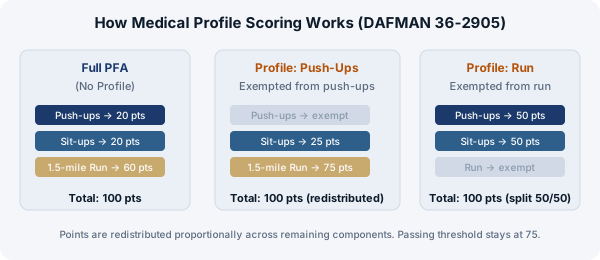
A medical profile doesn't excuse you from the PT test. It changes how the test is scored. That distinction matters significantly, and a surprising number of Airmen don't fully understand the mechanics until they're already in the process.
What a Medical Profile Is
A medical profile is a formal, documented limitation on physical activity or testing issued by a credentialed military medical provider. Profiles are generated through the Air Force medical system and recorded in the member's health record.
The documentation requirement is firm: a profile must come from a licensed provider in the military healthcare system. A note from a civilian doctor saying you shouldn't run is not an Air Force medical profile. It might support getting one, but it doesn't substitute for the formal military documentation.
Profiles are documented on a physical profile serial report (commonly referenced as AF Form 469 or equivalent under current DAFMAN 36-2905 procedures) and transmitted to the unit fitness program manager before the scheduled assessment date. Timing matters: a profile sitting in the medical system but not yet received by the UFPM doesn't protect you on test day.
Temporary vs. Permanent Profiles
Temporary profiles cover conditions expected to resolve: post-surgical recovery, stress fractures, soft tissue injuries. A temporary profile has a specific end date. Once that date passes, standard scoring resumes with no automatic extension.
Permanent profiles apply to conditions that won't resolve, such as chronic injuries and lasting physical limitations. Permanent profiles go through a more involved review process and often involve a Medical Evaluation Board (MEB) or Integrated Disability Evaluation System (IDES) review if the limitation affects duty performance.
For PT testing purposes, most profile situations Airmen encounter are temporary. The expiration date is the critical detail. If your profile expires 2 days before your scheduled assessment, you're testing under full standard scoring rules. Don't assume the profile still applies without verifying the exact end date with your UFPM.
How Profiled Components Are Scored: The Redistribution Formula
When a medical profile exempts one or more components, the Airman tests on the remaining components. The points from those components are redistributed to a 100-point scale.
The standard breakdown is: push-ups (20 points maximum), sit-ups (20 points maximum), 1.5-mile run (60 points maximum).
If an Airman is profiled from push-ups, the assessment is scored out of 80 total points (sit-ups 20 + run 60). The result is then scaled: actual points earned ÷ 80 × 100 = composite score.
An example: a sit-up score of 18 points and a run score of 52 points = 70 out of 80 = 87.5 composite. That's Satisfactory on the full scale, higher than the raw 70 suggests.
If both push-ups and sit-ups are profiled, only the run counts and the run score is scaled directly to 100 points. A run score of 54 out of 60 becomes a 90 composite. The math moves quickly.
The Air Force PT calculator automatically handles this redistribution when you enter results for only the components you're testing on.
What Happens If You're Profiled From the Run
The run carries 60% of the total score. A run profile has the largest mathematical impact of any single component exemption.
When the run is profiled, scoring is out of 40 points (push-ups 20 + sit-ups 20), then scaled to 100. An Airman scoring 17/20 on push-ups and 17/20 on sit-ups = 34 out of 40 = 85 composite. Achievable, but the scoring becomes extremely unforgiving. A push-up performance that would cost 3 composite points in a full test now costs approximately 7.5 composite points after scaling.
Some Airmen view a run profile as pressure relief on the hardest component. The scoring reality doesn't support that view. Without the run, you need near-perfect performance on both calisthenics components to score well, and any weakness in those events gets amplified by the redistribution formula.
Component minimums still apply under profiled scoring. If you're testing on two components, you need to meet the minimums for each of those components. Missing a minimum on an exempted component doesn't apply, but missing one on a tested component still results in an Unsatisfactory.
Pregnancy and Postpartum: The 180-Day Track
Pregnancy is handled under a specific track in DAFMAN 36-2905. A pregnant Airman is placed on a Pregnancy/Postpartum Profile and exempt from PT testing for the duration of pregnancy and for 180 days postpartum.
That 180-day window starts from the date of delivery, not the end of maternity leave, not the date of return to full duty. These dates can differ significantly, and the distinction matters for scheduling your return to the testing cycle.
During the postpartum window, no UFA can be recorded and the member is not enrolled in FIP for fitness assessment reasons. After 180 days, the Airman returns to the standard testing cycle on the next scheduled assessment.
The postpartum return deserves realistic planning. Returning to run fitness after pregnancy takes time, and the 180-day window doesn't always align with physiological readiness. Use the Air Force PT scoring tool to set score targets for your return and work backward from the test date to plan a training progression.
Scored-Only-Component Assessments
When a profile reduces the test to a single component, the scoring mechanics still follow the same redistribution logic. If only sit-ups are tested (both run and push-ups profiled), the sit-up score is scaled to 100 points. A score of 19 out of 20 becomes a 95 composite.
In practice, single-component assessments are uncommon. They typically require overlapping profiles on two separate events, which requires significant medical documentation. The more common scenario is a two-component assessment, usually run profiled or one calisthenics component profiled.
Returning From a Profile: When Standard Scoring Resumes
When a temporary profile expires, the Airman returns to full standard scoring on the next scheduled assessment. There's no grace period in the regulation. The assessment after the profile end date is evaluated identically to any other.
If a profile expires after a test was already completed under profiled scoring, that result stands on the record. The following assessment after expiration uses full standard scoring.
One important scenario: if your profile expires after a scheduled assessment date, you may still test under profile conditions if the profile is active on test day. Coordinate directly with your UFPM to confirm the exact profile end date and how it maps to the scheduled test date. Don't assume; verify in writing.
Profiled Assessments and Your Record
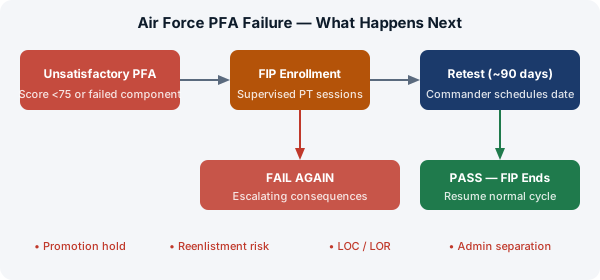
A profiled assessment that results in a composite of 75 or higher (under scaled scoring) counts as a valid passing fitness assessment for the testing cycle. It shows on the record that a profile was in place, which provides context for the modified scoring.
This distinction matters for performance reports. A profiled assessment that passes does not carry the negative weight of a UFA. The profile documentation explains the circumstances.
However, a profiled assessment that results in a score below 75, even under scaled scoring, is still an Unsatisfactory Fitness Assessment. A medical profile changes the math, not the pass threshold. Missing component minimums on tested events still produces an Unsatisfactory result.
Talk to Your MTF Provider Before the Test
If you have an injury or condition that may affect your ability to safely complete any component, talk to your Medical Treatment Facility provider before the assessment. Profiles cannot be retroactively applied to a test already completed.
If you tested injured and failed, that result stands. The profile process is pre-test documentation, not a post-failure appeal.
Early provider contact also gives time for formal documentation to move through the system and reach your UFPM before test day. The medical-to-unit communication pathway has its own timeline, and a profile that doesn't reach the UFPM before the test doesn't change how you're assessed.
For context on how full standard scoring works across age groups, see the complete PT test scoring guide. If your assessment resulted in an Unsatisfactory and you're wondering what comes next, the FIP and recovery process is covered in detail.
For more on how this site's scoring logic aligns with current DAFMAN 36-2905 guidance, visit the about page.