How to Improve Your Air Force PT Score in 8 Weeks
A structured 8-week training plan to raise your Air Force PT score, with specific workouts, run intervals, and push-up progressions built around the DAFMAN 36-2905 point system.
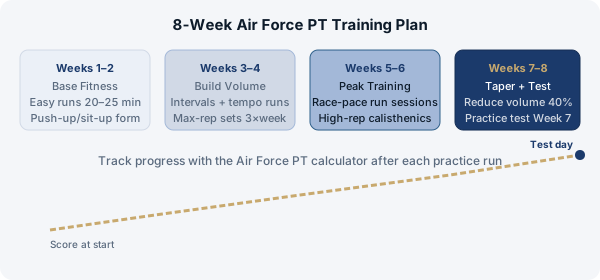
Eight weeks is enough time to meaningfully move your Air Force PT score if you train the right things in the right order. Most Airmen who plateau spend too much time on what they're already decent at and not enough on what's actually dragging their composite down.
Before you do anything else, run your current numbers through the Air Force PT calculator and see exactly where your points are coming from. That breakdown tells you where to focus. If your run is giving you 38 points and your push-ups are giving you 18, the math is obvious.
Why the Run Comes First
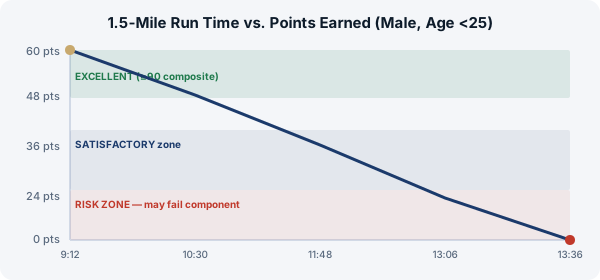
The 1.5-mile run is worth 60 points, or 60% of your total score. No other single investment of training time returns more points per hour. A male Airman in the 25–29 age group can go from 40 run points (roughly a 14:30 time) to 50 run points (around 12:30) in 8 weeks with consistent interval work. That's a 10-point swing on the composite, which can move you from a low Satisfactory to a solid one, or from Satisfactory into Excellent territory.
The calisthenics components cap at 20 points each. Even if you max both, you've added 40 points, and maxing both takes months. The run ceiling is higher and the gains come faster.
How the 8-Week Plan Is Structured
The plan has two phases:
- Weeks 1–4 (Base Building): Volume-focused. Build aerobic base, establish push-up and sit-up volume, identify form issues.
- Weeks 5–8 (Intensity): Speed work replaces base runs. Calisthenics shift to test-pace sets. Final week is taper and rehearsal.
Train 5 days per week. Rest or light walk on the other 2. Never train hard on back-to-back days. Recovery is where adaptation happens.
Week-by-Week Breakdown
Weeks 1–2: Establish Your Base
Monday / Wednesday / Friday: Run days
- 20-minute easy run at a conversational pace
- You should be able to talk in short sentences
- Keep heart rate below 75% of max
Tuesday / Thursday: Calisthenics
- 4 sets of push-ups to 60% of your current max (rest 90 seconds between sets)
- 4 sets of sit-ups to 60% of your current max
- Example: if your max is 40 push-ups, do sets of 24
Goal by end of Week 2: Run 20 minutes without stopping, establish baseline rep counts.
Weeks 3–4: Add Volume
Monday / Wednesday / Friday: Run days
- Monday: 25-minute easy run
- Wednesday: 2-mile run (or 25 minutes, whichever is farther)
- Friday: 20-minute run with 4 x 30-second pickups at 5K effort, spaced 3 minutes apart
Tuesday / Thursday: Calisthenics
- 5 sets of push-ups to 65% of max, 90-second rest
- 5 sets of sit-ups to 65% of max
- Add 1 set of diamond push-ups per session (triceps strength)
Goal by end of Week 4: Notice your easy pace getting slightly faster at the same effort level.
Weeks 5–6: Introduce Intervals
This is where run scores move the most. Interval training teaches your body to sustain faster paces.
Monday: Interval session
- Warm up 5 minutes easy
- 6 x 400 meters at your goal 1.5-mile pace (or slightly faster)
- Rest: 90 seconds between each
- Cool down 5 minutes easy
To find your goal 400m split: take your goal 1.5-mile time, divide by 6. If your goal is 12:00, your goal 400m split is 2:00.
Wednesday: Tempo run
- 5-minute easy warm-up
- 12 minutes at a "comfortably hard" pace where you can say a few words but not hold a conversation
- 5-minute easy cool-down
Friday: Easy run
- 25 minutes easy, truly easy, because this is recovery
Tuesday / Thursday: Calisthenics
- 4 sets of push-ups at 75% of max, 2-minute rest
- 4 sets of sit-ups at 75% of max
- Practice test-condition sets: 1 max set with 1-minute rest, then continue to 70% again
Weeks 7–8: Race-Pace Work and Peak
Monday: Interval session
- 8 x 400 meters at goal 1.5-mile pace, 75-second rest between reps
- This is hard. It should feel hard.
Wednesday: 1.5-mile time trial
- Full warm-up: 5 minutes easy, then 4 x 20-second strides
- Run a full test-pace 1.5 miles
- Record your time and enter it in the AFPT score estimator immediately after, because seeing actual points is motivating
Friday: Easy 20 minutes (taper begins)
Tuesday / Thursday: Calisthenics peak sets
- 3 max sets push-ups with 3-minute rest between
- 3 max sets sit-ups with 3-minute rest between
- Log your counts each session
Week 8 (Test Week): Drop volume by 50%. No hard runs after Tuesday. Do one light calisthenics session Wednesday. Rest Thursday. Test Friday or Saturday.
Tracking Progress with the Calculator
Every Wednesday from Week 4 onward, log your current push-up max, sit-up max, and most recent run time. Plug them into the composite score tool to see your projected score in real time. This does two things: it keeps you honest about which component needs more attention, and it gives you a concrete target to close in on.
If your projected score is 81 and you need 90 for Excellent, the gap breakdown will show you whether the remaining 9 points are more accessible through the run or through calisthenics. Usually it's the run.
Push-Up and Sit-Up Progressions
The goal isn't just volume. It's test-specific performance. Under DAFMAN 36-2905 testing conditions, push-ups and sit-ups are done with a grader watching form. Partial reps don't count.
Progressive overload looks like this:
- Week 1: 4 sets at 60% max
- Week 2: 4 sets at 65% max
- Week 3: 5 sets at 65% max
- Week 4: 5 sets at 70% max
- Week 5: 4 sets at 75% max, plus 1 max set
- Week 6: 4 sets at 75% max, plus 2 max sets
- Week 7: 3 max sets with full rest
- Week 8: 2 max sets only (taper)
Never train push-ups to failure every session. Failure-to-failure training induces form breakdown and increases injury risk without proportionate strength gain.
Nutrition and Sleep
You don't need to overhaul your diet for an 8-week PT prep cycle. Three things matter:
- Eat enough protein: roughly 0.7–1.0 grams per pound of bodyweight daily. This supports muscle repair after calisthenics work.
- Don't undereat on run days: running on empty degrades workout quality and recovery.
- Get 7–9 hours of sleep: more than any supplement, sleep drives cardiovascular adaptation and strength gains.
When 8 Weeks Isn't Enough
If your current score is below 65, especially if you're failing a component minimum, 8 weeks may not get you to 75. It can get you significantly closer, and a second 8-week cycle can finish the job.
The plan works best when your starting point is Satisfactory territory (75–84) and you're aiming for Excellent (90+), or when you're in the 68–74 range trying to clear the 75 threshold.
For component-specific training depth, see our guides on 1.5-mile run strategy and push-up/sit-up form. Both cover the technical details that separate a 16-point calisthenics score from a 20.
For details on how this calculator implements DAFMAN 36-2905 scoring, see the about page.