Air Force vs Army PT Test: Key Differences Explained
The Air Force PT test and Army ACFT differ in events, scoring philosophy, and what fitness they actually measure. Here is a direct comparison of both assessments.
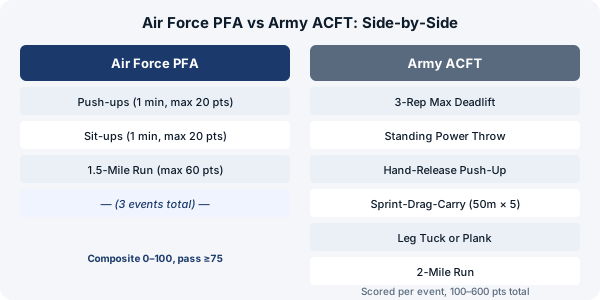
The Air Force Physical Fitness Assessment and the Army Combat Fitness Test are both military fitness tests, and that's roughly where the similarities end. The two assessments reflect genuinely different ideas about what physical fitness means for their respective services.
If you're transitioning between branches, in a joint-service assignment, or just curious how the standards compare, here's a direct breakdown.
The Events: 3 vs. 6
The Air Force PFA has three events: push-ups, sit-ups, and a 1.5-mile run. Every Airman takes the same three events (adjusted by gender and age group for scoring). That's the whole test.
The Army Combat Fitness Test has six events, administered in this order:
- 3-repetition maximum deadlift: Tests lower body and posterior chain strength. Weight moved varies; soldiers must complete 3 reps at a chosen weight.
- Standing power throw: A 10-pound medicine ball thrown backward overhead. Tests explosive power.
- Hand-release push-up: Standard push-ups with a full hand release from the ground at the bottom of each rep, removing the elastic energy benefit of a standard push-up.
- Sprint-drag-carry: Five 50-meter shuttles carrying different loads: a sprint, a sled drag (90 lbs), a lateral shuffle, two 40-lb kettlebell carries, and a final sprint. Tests anaerobic conditioning and load-bearing capacity.
- Leg tuck or plank: The leg tuck requires hanging from a pull-up bar and bringing knees to elbows. Soldiers who can't perform a leg tuck substitute a 2-minute plank hold.
- 2-mile run: The aerobic endurance event. Same concept as the Air Force 1.5-mile but longer.
The ACFT takes roughly 50–60 minutes to administer for a single soldier. The AFPT takes 30–40 minutes.
Scoring Philosophy: Composite vs. Functional Standards
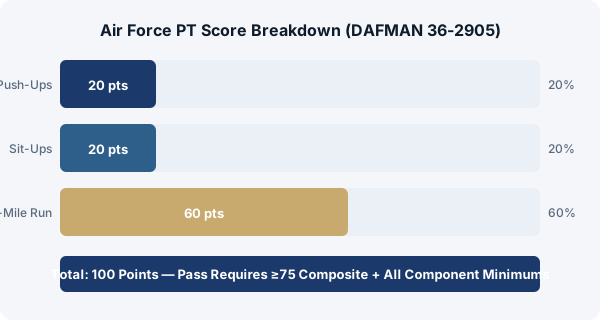
The Air Force assessment uses a composite scoring system. Push-ups are worth up to 20 points, sit-ups up to 20 points, and the 1.5-mile run up to 60 points, for a 100-point composite. You need 75 to pass and must meet component minimums. Scores of 90 or above earn an Excellent rating.
The ACFT uses a per-event scoring system with a total composite, but passing requires meeting a minimum score on each individual event separately. There's no trading off a great deadlift against a weak power throw. You need to pass each event, then your total score determines your overall standing.
ACFT scoring is also tiered by Military Occupational Specialty (MOS), where combat arms MOSs have higher minimum passing scores per event than support MOSs. The Air Force applies age and gender adjustments within a single passing threshold.
The Aerobic Weight: 60% vs. Roughly 17%
This is the most important structural difference for athletes deciding where to focus training.
On the Air Force test, the 1.5-mile run is worth 60 points out of 100, which is 60% of the total. If you run poorly, you cannot compensate with calisthenics performance. The run is the test.
On the ACFT, the 2-mile run is one of six events. Even if each event were weighted equally, that's roughly 17% of your total score. In practice, the run matters, but a strong performance in the strength and power events can offset a slower run time, as long as you meet the run minimum for your MOS tier.
This difference shapes how service members train. Airmen who want high composite scores spend the majority of their training time on aerobic conditioning. Army soldiers preparing for the ACFT need a more balanced program covering strength, power, and anaerobic capacity alongside aerobic endurance.
Which Test Is Harder?
The honest answer: it depends on your fitness background.
For someone with strong endurance but limited strength training experience, the ACFT is harder. The deadlift, power throw, and sprint-drag-carry require movement patterns and strength qualities that steady-state cardio training doesn't develop. A runner who can post a 10:30 2-mile may still struggle with the deadlift or power throw if they've never trained for it.
For someone with a strength background who hasn't prioritized running, the AFPT run is the harder challenge. The 1.5-mile run worth 60 points leaves no room to hide. A male Airman in the 25–29 age group needs to run 1.5 miles in 13:36 to score 51 points, which is a 9:04-per-mile pace for a mile and a half. To hit 75 composite on the run alone would require a finish around 11:57 (roughly 7:58/mile pace for the full distance), scoring 60 points.
The ACFT is more physically demanding in total body terms. The AFPT is more demanding in a single aerobic capacity dimension.
Who Is Subject to Which Test
Active duty, Reserve, and Air National Guard Airmen take the Air Force Physical Fitness Assessment. Frequency is typically annual for most members, with some populations testing more frequently.
Active duty, Reserve, and Army National Guard soldiers take the ACFT. Soldiers are tested twice per year under current Army policy.
DAF civilians and contractors are not subject to the AFPT. The same is true for Army civilians on the ACFT.
Joint-Service Members and Dual Standards
Airmen serving in joint billets, assigned to an Army or joint command, typically remain subject to Air Force fitness standards under DAFMAN 36-2905. The branch you're assigned to administratively determines which test applies.
However, joint command culture and unit norms can vary. Some joint assignments informally expect participation in Army PT formations, which may follow ACFT-style programming. Your administrative record still reflects the Air Force standard, but the day-to-day training environment may look different.
If you're an Airman in a joint billet and your current 1.5-mile run time would score poorly on the AFPT, check your numbers using the Air Force PT score calculator and make sure your aerobic fitness is test-ready on the Air Force standard, even if the unit around you is training for something different.
A Side-by-Side Snapshot
| Feature | Air Force PFA | Army ACFT |
|---|---|---|
| Number of events | 3 | 6 |
| Aerobic event | 1.5-mile run | 2-mile run |
| Strength test | Push-ups, sit-ups | Deadlift, power throw, sprint-drag-carry |
| Scoring | 100-point composite | Per-event minimums + composite |
| Run weight | 60% of total | ~17% of total |
| MOS/AFSC-based standards | Age/gender adjustments only | MOS tier minimums |
| Test frequency | Annual (typical) | Twice per year |
| Duration | ~30–40 minutes | ~50–60 minutes |
What the Different Tests Measure
The Air Force assessment is built around aerobic capacity and basic muscular endurance. The 60-point run reflects a service philosophy that cardiovascular fitness is the core physical readiness requirement for most Airmen, most of the time.
The ACFT is built around combat readiness in a physical environment. The events, particularly the deadlift, power throw, and sprint-drag-carry, simulate load-bearing, explosive actions, and anaerobic bursts under fatigue that ground combat soldiers encounter. The Army explicitly redesigned the ACFT to better predict soldier performance in physically demanding combat situations.
Neither test is wrong. They reflect different mission profiles. A security forces Airman in a forward environment has different physical demands than a sensor operator at a stateside base. The ACFT doesn't make sense for every Air Force population; the AFPT doesn't fully capture combat readiness for every Army population.
For context on how Air Force scoring breaks down by age and gender, see the AFPT scoring standards guide. If you're preparing for an upcoming assessment, the age-group PT standards breakdown covers what each demographic needs to hit the Excellent and Satisfactory thresholds.
Use the AFPT calculator to see exactly where your run, push-up, and sit-up numbers land in the Air Force composite system. It's the fastest way to identify where your training time returns the most points.
For details on how this calculator implements DAFMAN 36-2905 scoring, see the about page.