Air Force PT Test Scoring: How Your Score Is Calculated
Learn exactly how Air Force PT test scoring works under DAFMAN 36-2905, including component points, composite totals, and what separates Excellent from Unsatisfactory.
Your Air Force Physical Fitness Assessment score isn't a mystery. It's a math problem. Once you understand how each component feeds into your composite score, you can stop guessing and start planning.
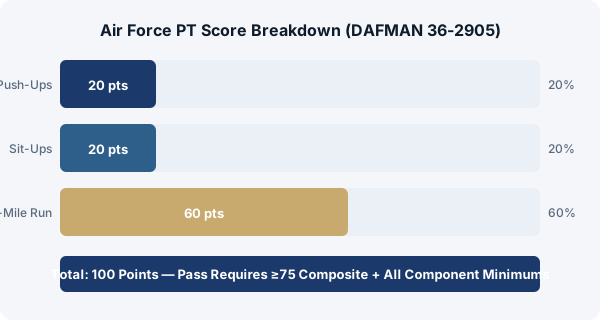
DAFMAN 36-2905 governs the entire scoring system. The assessment has three components: push-ups, sit-ups, and the 1.5-mile run. Each contributes a fixed maximum to your composite score, but the run carries far more weight than most Airmen expect.
The Three Components and Their Point Values
Here's exactly how the 100-point composite breaks down:
| Component | Maximum Points | Percentage of Score |
|---|---|---|
| Push-ups | 20 pts | 20% |
| Sit-ups | 20 pts | 20% |
| 1.5-mile run | 60 pts | 60% |
| Total | 100 pts | 100% |
The run is worth three times what either calisthenics component is worth. A 30-second improvement in your run time can swing your composite score by 4–6 points, the equivalent of doing 10 extra push-ups. That math matters when you're building a training plan.
Performance Ratings Explained
Your composite score maps to one of three ratings:
- Excellent: 90.0 or higher
- Satisfactory: 75.0 to 89.9
- Unsatisfactory: below 75.0, OR failing any component minimum
That last condition is the one that trips people up. You can score a 95 composite and still get an Unsatisfactory if you don't hit the minimum for push-ups, sit-ups, or your run time. Both conditions must be met: composite AND component minimums.
The Component Minimum Rule
Every age group and gender combination has a minimum score for each event. Falling below any single minimum automatically results in Unsatisfactory, regardless of your total.
For a 25-year-old male, the push-up minimum is 33 repetitions (earning roughly 14.1 component points). The sit-up minimum is 38 reps. The run minimum is 16:00, and anything slower than that means the test is over before your composite is even calculated.
For a 25-year-old female, the push-up minimum is 18 reps, sit-up minimum is 32, and the run minimum is 18:30.
These minimums aren't negotiable. They exist so that no single strong performance can mask a complete failure in another event.
How Points Are Awarded Within Each Component
Points aren't assigned on a straight linear scale. The scoring tables use brackets. Within each bracket, you earn a set number of points. As your performance increases, you move up to a higher bracket and earn more points, up to the component maximum.
For male Airmen aged 25–29, push-up scoring looks roughly like this:
| Push-Ups Completed | Points Awarded |
|---|---|
| 33 (minimum) | ~14.1 |
| 39 | ~16.0 |
| 45 | ~18.0 |
| 51 | ~20.0 (max) |
Hitting the maximum isn't always practical under test conditions. But knowing the thresholds lets you set realistic targets. If you're at 42 push-ups, you're close to the 16-point bracket, and a few weeks of targeted training could close that gap.
A Worked Example: 28-Year-Old Male
Let's say a 28-year-old male completes:
- Push-ups: 42 reps → approximately 16.5 points
- Sit-ups: 47 reps → approximately 17.0 points
- 1.5-mile run: 12:45 → approximately 49.5 points
Composite: 16.5 + 17.0 + 49.5 = 83.0, Satisfactory
He met all component minimums. The rating is Satisfactory. But notice that even though his calisthenics were solid, the run pulled his composite down from what could have been an Excellent. Dropping his run time to 11:30 would likely push him past 90.
Use the Air Force PT calculator to run these numbers for your own age group and inputs. The score tables are built in.
A Worked Example: 35-Year-Old Female
A 35-year-old female completes:
- Push-ups: 27 reps → approximately 16.0 points
- Sit-ups: 38 reps → approximately 16.5 points
- 1.5-mile run: 14:30 → approximately 44.0 points
Composite: 16.0 + 16.5 + 44.0 = 76.5, Satisfactory
She passed all minimums and cleared 75. She's in Satisfactory territory, but just barely. Shaving 45 seconds off her run would likely push her past 80. That's a meaningful difference at promotion boards.
Age Groups and How They Affect Scoring
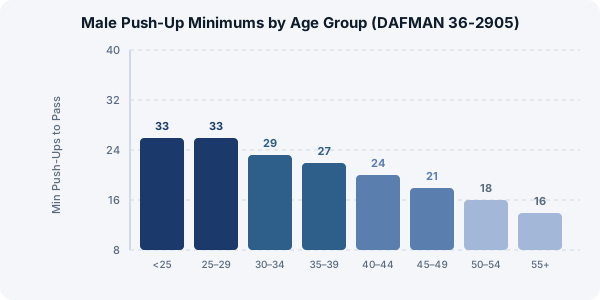
DAFMAN 36-2905 breaks scoring into age bands. The 9 male and 9 female age groups are:
- Under 25
- 25–29
- 30–34
- 35–39
- 40–44
- 45–49
- 50–54
- 55–59
- 60 and over
As age increases, the performance thresholds for each point bracket are adjusted downward. A 50-year-old male needs fewer push-ups to earn the same number of points as a 25-year-old. The system recognizes that fitness capacity changes with age. The scoring is age-adjusted, not age-exempt.
This means comparing raw scores across age groups isn't straightforward. An Excellent score at 28 requires different absolute performance than an Excellent at 48.
What Happens After an Unsatisfactory
An Unsatisfactory triggers mandatory follow-up. Members are enrolled in the Fitness Improvement Program (FIP), which is a structured reconditioning plan supervised by a Fitness Assessment Cell representative or Unit Fitness Program Manager. You must retest within 90 days of your failed assessment. During FIP, you'll follow a prescribed training program designed to bring your weakest component up to the minimum standard.
Repeated Unsatisfactory ratings carry escalating consequences. A second failure within a 24-month period can affect promotion eligibility, reenlistment, and assignment options. Commanders may also initiate administrative actions. The FIP itself is documented in your fitness history, so even after passing the retest, the Unsatisfactory remains on your record for the tracking period.
A single Unsatisfactory isn't career-ending, but the pattern matters. Knowing your weak component now, before test day, gives you time to address it. Check out our methodology to see how we've validated the scoring tables used in this tool.
Common Scoring Misconceptions
"I just need a 75 overall." Not quite. You need a 75 AND all component minimums. A 77 composite with a failed push-up minimum is still Unsatisfactory.
"Push-ups and sit-ups don't matter much." They're 40% of your score combined. Maxing both is worth 40 points, the difference between a 55 and a 95 if your run puts you at 55.
"If I max the run, I can skip training push-ups." You'd need 60 run points plus 15 points across two calisthenics components to hit 75. That math works on paper, but a single failed minimum breaks it.
The best strategy: treat all three events seriously, prioritize the run since it has the highest ceiling, but never let either calisthenics component fall below minimum.
If you want to see exactly where you'd land under real scoring tables, the Air Force fitness score estimator gives you an instant breakdown by component.