10 PT Test Day Tips to Maximize Your Air Force Score
Small test-day decisions add up to real points on your Air Force PT score. These 10 specific strategies help you perform at your actual fitness level, not below it.
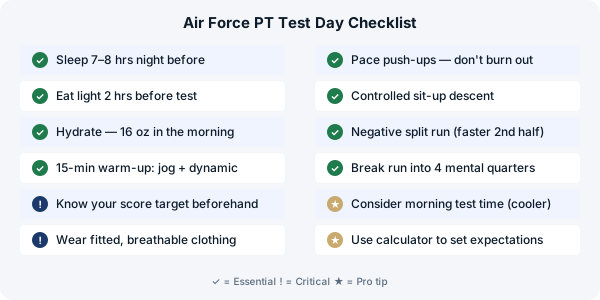
Your fitness is set weeks before test day. What test-day preparation controls is whether you perform at your actual ceiling, or 5 to 10 points below it because of avoidable mistakes. These 10 tips are specific and actionable.
1. Sleep and Nutrition the Night Before
Get at least 7 hours. Sleep deprivation measurably reduces muscular endurance and cardiovascular output, the two physical qualities the AFPT measures. Research on military sleep consistently shows that even one night of poor sleep reduces maximal push-up and run performance by a meaningful margin.
The night-before meal matters too. Eat a normal dinner, not a massive carb-load, not a skipped meal. Something with protein, carbohydrates, and fats, finished 2–3 hours before bed. Your body needs glycogen for the run. It doesn't need to be processing a large meal while you try to sleep.
Avoid alcohol the night before. Even one drink disrupts sleep architecture and elevates resting heart rate the next morning, both of which hurt run performance specifically.
2. Warm Up Properly
A 15-minute warm-up changes your test. Start with 5–7 minutes of easy jogging, slow enough to hold a conversation. Follow with dynamic stretches targeting hip flexors, hamstrings, and shoulders: leg swings (forward and lateral, 10 reps each leg), arm circles, high knees, and butt kicks for 30 seconds each. Finish with 4–5 push-up practice reps and 4–5 sit-up practice reps to activate the specific movement patterns the test will demand.
Do not stretch statically before the test. Holding stretches for 30+ seconds reduces force production for up to 30 minutes afterward. Save static stretching for post-test recovery.
Start your warm-up 25–30 minutes before your first event so you're warm but not fatigued when the clock starts.
3. Hydration Timing
Arrive hydrated, but not waterlogged. The target: 16–20 oz of water in the 2 hours before the test. Don't drink a full liter 30 minutes before you start; a sloshing stomach during the run slows you down and causes real discomfort.
If you're testing in heat (more on that in tip 7), add an extra 8 oz in the hour before the test. Electrolyte balance matters in hot conditions, and plain water alone isn't always enough if you've been sweating in pre-test formation.
Don't introduce caffeine within 90 minutes of the run unless you're a habitual daily coffee drinker. For habitual users, a moderate dose can improve run performance. For infrequent users, the jitters and heart rate spike hurt more than the stimulant helps.
4. Push-Up Pacing Strategy
The most common push-up mistake: going to failure in the first 30 seconds and spending the remaining 90 seconds grinding out singles. One push-up every 5 seconds after an early collapse produces a poor final count.
Instead, calculate 70–75% of your estimated maximum and hold that pace for the first 45 seconds. If your max is 50 push-ups, aim for 35 in the first 45 seconds, then push hard through the final 15 seconds of the set. This pacing strategy leaves capacity in reserve and produces a higher total than an all-out-then-collapse approach.
Keep your hips aligned. No snaking, no piking. Form breaks that get called by the evaluator don't count. A clean rep that scores beats a fast rep that doesn't.
5. Sit-Up Pacing and Descent Control
Sit-ups reward a controlled descent more than raw speed. The up phase can be quick; the down phase should take about 1–1.5 seconds. Uncontrolled flop-downs fatigue hip flexors faster and make the final 20 seconds extremely difficult.
Establish a rhythm in the first 15–20 reps and stick to it. Many Airmen who miss their target sit-up count went too fast early, lost rhythm, and spent the back half fighting cramps. Consistent cadence beats sprint-and-rest patterns for sit-up totals.
Hands stay clasped behind your head with fingers interlaced throughout. Evaluators watch for hand position breaks. A consistent grip prevents rep disqualifications.
6. Run Pacing: The Negative Split
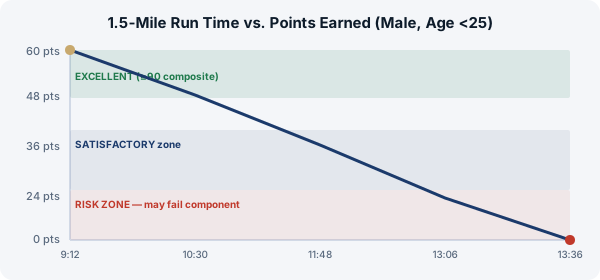
A negative split means running the second half faster than the first. For a 1.5-mile test, that typically means running the first 0.75 miles 10–15 seconds per mile slower than goal pace, then building speed from the halfway mark.
Most Airmen do the opposite. They go out fast on adrenaline, hit their anaerobic threshold too early, and slow dramatically through the back half. A male Airman targeting a 12:00 finish (scoring approximately 55 points in the 25–29 age group) should aim for a first half around 6:10 and a second half around 5:50, not two equal 6:00 halves.
The final 400 meters is where points are won or lost. Know your target finish time, keep a running mental clock, and save your kick for the last quarter-mile.
7. Weather Considerations
Heat is the biggest environmental variable. At 85°F or above, most people run 30–90 seconds slower on a 1.5-mile course than they would at 65°F. Your heart works harder to cool the body, leaving less cardiac output for forward movement.
In hot conditions: start 5–10 seconds per mile slower than usual. Use any available shade during warm-up. If ice or cold towels are available at the test site, use them before the run. Pre-cooling has measurable performance benefits in heat.
Cold weather below 35°F increases your warm-up time requirement. Add 5 minutes to your pre-test jog to ensure your muscles are genuinely warm. Cold muscles produce less force and are more prone to strain.
Wind on an out-and-back course matters directionally. Running into a headwind in the first half means a tailwind assist on the return. Factor that into your pacing split. Don't fight the headwind unnecessarily in the first 0.75 miles.
8. Clothing Choices
Fitted but not tight. Compression shorts or fitted running shorts move with your body during push-ups and sit-ups without riding up or restricting hip flexion. Loose shorts bunch during sit-ups and can make it harder for an evaluator to assess your range of motion cleanly.
Wear running shoes you've used in training, not new ones for the first time on test day. New shoes change your gait subtly and can cause blisters or hot spots during the run.
Avoid cotton. Moisture-wicking material reduces chafing and helps regulate core temperature. In heat, cotton soaks and stays saturated; technical fabric manages sweat actively.
If you train with insoles or orthotics, wear them. Don't swap footwear setup on the day you're being evaluated.
9. Mental Strategy for the Run
Break the 1.5-mile into four equal quarters, 0.375 miles each. At the start of each segment, check in: pace comfortable, breathing controlled, still on target. Four short mental segments are far easier to manage than one long continuous effort.
At the halfway mark and on pace, give yourself a brief mental acknowledgment. You're on track. At the 1.1-mile point, when it gets genuinely hard, remind yourself there's 0.4 miles left. That's roughly 3 minutes of discomfort. You can sustain discomfort for 3 minutes.
Don't respond to other people's paces. The Airman sprinting past you at mile 1 may be going out too hard. Run your plan.
10. Know Your Score Targets Going In
Test day is not the time to figure out what score you need. That calculation belongs to the night before, or the week before.
Pull up the Air Force PT score calculator and work out exactly what push-up count, sit-up count, and run time produces your target composite. Know all three numbers. Write them down if it helps.
If you need 85 composite as a male Airman aged 30–34, that means roughly 47 push-ups (17 pts), 50 sit-ups (16 pts), and a 1.5-mile time around 12:15 (52 pts), totaling 85 composite. Knowing those numbers in advance means you pace toward specific targets rather than hoping the overall effort lands where you need it.
Also calculate your floor: what's the minimum combination that gets you to 75? You don't want to aim for the floor, but knowing it prevents panic if one event goes slightly worse than planned.
Airmen who consistently score at their training level on test day usually share one trait: they arrived knowing exactly what they needed from each event and executed a plan instead of reacting to how they felt in the moment.
For the training that builds the fitness behind these strategies, read the guide on Air Force PT run improvement techniques and the full breakdown of push-up and sit-up training progressions.
For more on how the scoring standards used in this calculator are validated, see the about page. And if you want a second score estimate before your test, the DAFMAN 36-2905 PT score tool takes under a minute to run.