Push-Up and Sit-Up Training Plan for the Air Force PT Test
Max your Air Force PT push-up and sit-up scores with proper form, progressive overload, and a weekly plan that prevents overtraining while building real reps.
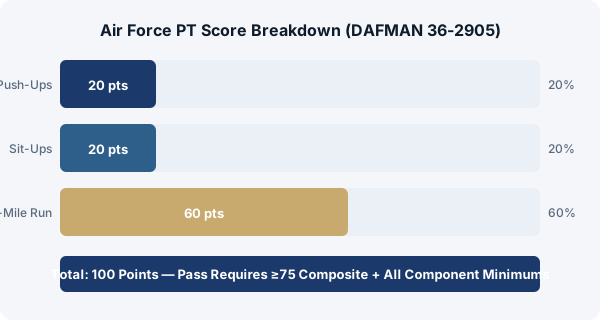
Push-ups and sit-ups are worth 40 points combined on the Air Force PT test, 20 each. Maxing both components is achievable for most Airmen, but it requires more than just doing push-ups until your arms give out. It requires correct form, progressive volume, and the discipline to not overdo it.
Most Airmen who plateau at 15–17 push-up points aren't weak. They're either training with bad form that bleeds over into test day, or they're grinding through max-effort sets so frequently that they never fully recover.
What the Air Force Counts and What It Does Not
Under DAFMAN 36-2905 standards, push-up and sit-up form is strict. Reps that don't meet standards aren't counted. Knowing the rules before you train prevents you from building bad habits that cost you points on test day.
Push-Up Standards
- Start in the up position: arms fully extended, body forms a straight line from head to heels
- Lower until upper arms are at least parallel to the ground (elbows at approximately 90 degrees)
- Return to full arm extension
- Hips must stay in line, with no sagging or piking
- Hands must stay shoulder-width or slightly wider
Common errors that don't count:
- Partial range, not going low enough (most common failure)
- Snaking the head down while hips stay up
- Locking elbows and resting at the top
- Collapsing core mid-set (hips drop)
The grader will call out "no rep" for form breaks. In practice, train every rep as if a grader is watching. Sloppy reps in training become sloppy reps under test pressure.
Sit-Up Standards
- Start flat on your back, knees bent at approximately 90 degrees, feet held by a partner
- Fingers interlaced behind the head (or crossed on chest, depending on current reg version, so verify with your unit fitness program manager)
- Rise until elbows touch or pass the knees
- Lower back to the starting position with shoulder blades touching the mat
Common errors that don't count:
- Not reaching the knees
- Using momentum from a bounce rather than muscle control
- Pulling on the neck with the hands
- Lifting the hips off the mat to complete the rep
One full minute of each event. Know your pace. If your max is 45 sit-ups, that's one rep every 1.3 seconds, a controlled but brisk rhythm.
How Many Points Do You Actually Need?
Before building a training plan, know your target. For a 30-year-old male:
- The sit-up minimum is 34 reps (you pass the component, but score roughly 11 points)
- 45 reps earns approximately 16 points
- 50 reps earns approximately 18 points
- 50+ reps maxes at 20 points
For push-ups in the same bracket:
- The minimum is 28 reps (~12 points)
- 38 reps earns approximately 16 points
- 45 reps earns approximately 18 points
- 45+ reps approaches the 20-point max
Use the Air Force PT score calculator to see exactly where your current rep counts place you in your specific age group. The tables differ for every bracket, so a 35-year-old and a 25-year-old earn different points for the same number of reps.
The Core Training Principle: Progressive Overload
Progressive overload means incrementally increasing training stress over time to drive adaptation. For calisthenics, that means adding reps, adding sets, or reducing rest, one variable at a time.
Don't do this: Max set, rest 3 minutes, max set, rest 3 minutes, every day. This produces temporary soreness but minimal long-term adaptation and a high injury risk.
Do this instead: Work at 60–75% of your current max for multiple controlled sets, progress that volume week over week, and save true max efforts for once or twice per week.
Weekly Training Structure
Train push-ups and sit-ups 4 days per week. Never train the same muscle group to failure on consecutive days. You need 24–48 hours for muscular repair.
Sample Week (4 days on, 3 off or active recovery):
| Day | Session Focus |
|---|---|
| Monday | Volume sets: 5 sets at 70% max, 90-sec rest |
| Tuesday | Rest or light cardio only |
| Wednesday | Strength sets: 4 sets at 80% max, 2-min rest |
| Thursday | Rest |
| Friday | Max test simulation: 1 max set, rest 3 min, 1 max set |
| Saturday | Volume sets: 5 sets at 70% max (same as Monday) |
| Sunday | Rest |
This structure gives you two volume days, one strength day, and one simulation day per week. All four matter. The simulation day tells you where you actually are; the other three build you up.
Progressive Overload Week by Week
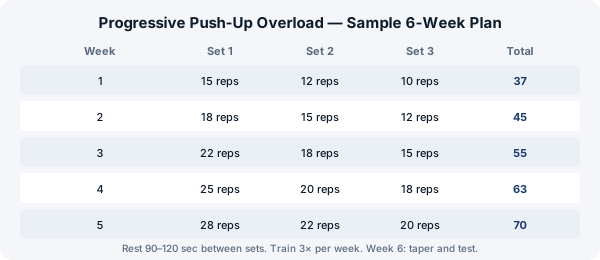
Here's how to advance across a 6-week cycle. Your starting 70% number is based on your current max, so test it on Day 1 before you begin.
Example: Airman with a current max of 35 push-ups
| Week | Session Type | Reps per Set | Sets |
|---|---|---|---|
| 1 | Volume | 24 (70% of 35) | 5 |
| 2 | Volume | 25 | 5 |
| 3 | Volume | 26 | 5 → 6 |
| 4 | Volume | 27 | 6 |
| 5 | Strength | 30 (85% of current max) | 4 |
| 6 | Taper | 22 | 3 |
Retest your max in Week 7. Most Airmen see a 5–10 rep improvement after one full cycle.
The same structure applies to sit-ups. Run both progressions simultaneously. There's no conflict between push-up and sit-up training sessions since they use different muscles.
The Grease-the-Groove Method for Fast Gains
Grease-the-groove (GTG) is a technique developed by strength coach Pavel Tsatsouline. The idea: perform multiple sub-maximal sets throughout the day, every day, without ever reaching failure. This builds the neurological pattern for the movement, and your nervous system gets better at recruiting muscle fibers efficiently.
GTG protocol for push-ups:
- Every 2–3 hours throughout the workday, do a set of push-ups at exactly 50% of your current max
- Example: if your max is 30, do 15 reps every 2–3 hours
- Stop at 50%. Not 16. Not 17. Stop at exactly half.
- Don't do this on the day before or the day of a hard training session
Over 4 weeks of GTG, many Airmen report 8–15 rep increases in their single-set max. It's not magic. It's accumulated volume without accumulated fatigue.
Warm-Up Protocol Before Every Session
A proper warm-up reduces injury risk and improves session performance. It takes less than 5 minutes.
- 60 seconds arm circles: forward and backward, full range of motion
- 10 inchworms: walk hands out to push-up position, walk feet back, stand
- 10 scapular push-ups: in push-up position, protract and retract shoulder blades without bending elbows
- 10 slow bodyweight squats: warm up hip flexors for sit-ups
- 10 slow leg raises: lying flat, raise legs to 90 degrees, lower slowly
Never start a hard push-up session cold. Shoulder injuries from cold training set you back weeks.
Avoiding Overtraining
The most common mistake in PT prep is doing too much too fast. Signs you're overtraining:
- Your rep counts are declining session over session
- You feel a persistent dull ache in your shoulders, elbows, or lower back
- You're not sleeping well despite physical fatigue
- You feel unmotivated or flat during sessions
If you hit these signs, take 3 full rest days before resuming. Reduce volume by 20% when you restart.
The body doesn't get stronger during training. It gets stronger during recovery. Programming rest is as important as programming reps.
Connecting Calisthenics to Your Composite Score
Push-ups and sit-ups combined are worth 40 points, but 60% of your score comes from the run. Don't neglect the run while you're building calisthenics volume.
A realistic composite-score goal looks like this for a 28-year-old male:
- Push-ups: 45 reps → approximately 18 points
- Sit-ups: 50 reps → approximately 18 points
- Run: 12:00 → approximately 56 points
- Composite: ~92, Excellent
That push-up and sit-up performance is achievable in 8–12 weeks for someone starting around 30–35 reps. The run training happens in parallel.
For the full combined program, see the 8-week Air Force PT improvement plan, which integrates run intervals with calisthenics on the same weekly schedule. And if you want to track your progress in real time, the AFPT score estimator converts raw rep counts into component scores instantly, so you can see whether your training is translating into actual points.
For more on how we validate scoring against official DAFMAN 36-2905 standards, see the about page.