1.5-Mile Run Strategy: Shave Minutes Off Your AFPT Time
The 1.5-mile run is 60% of your Air Force PT score. Learn pace strategy, interval workouts, and split targets that translate directly into more points.
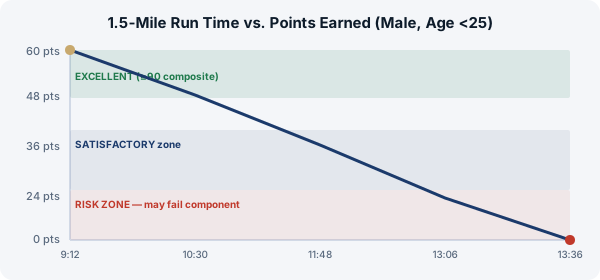
The 1.5-mile run is the single biggest lever in your Air Force PT score. It's worth 60 points, three times what push-ups or sit-ups are worth. If you're trying to move your composite from a 78 to a 90, the run is almost certainly where those 12 points are hiding.
Most Airmen treat the run as an afterthought until they see their score breakdown. Don't make that mistake. The run deserves the majority of your training time.
What Run Times Mean in Points
Point values vary by age group and gender, but here's what the scoring looks like for a male Airman in the 25–29 bracket to illustrate the stakes:
| 1.5-Mile Time | Approximate Points |
|---|---|
| 16:00 (minimum) | ~32.0 |
| 14:30 | ~40.0 |
| 13:00 | ~48.0 |
| 11:57 | ~56.0 |
| 10:51 | ~60.0 (max) |
The jump from 14:30 to 13:00 is 8 points, the equivalent of doing 5–6 more push-ups. For a 35–39 female bracket, the same time improvement produces a similar point gain. Plug your current time into the Air Force PT calculator to see exactly where your run sits on the scoring table for your specific age group.
Why Pace Strategy Matters More Than Raw Fitness
Most Airmen who underperform on the 1.5-mile run don't fail because they aren't fit enough. They fail because they go out too fast and die in the final half-mile.
The 1.5-mile run is short enough that it feels like a sprint and long enough that an all-out sprint from the start will leave you crawling for the last 400 meters. The optimal strategy is even pacing with a strong final quarter.
Your goal: run each quarter-mile within 5 seconds of your target split.
Calculating Your Target Splits
Divide your goal time into quarter-mile splits. For a 12:00 goal time:
- Quarter-mile split: 12:00 ÷ 6 = 2:00 per quarter
- Mile split: 8:00
- Final quarter push: aim to run the last quarter in 1:50–1:55
For a 13:30 goal:
- Quarter-mile split: 13:30 ÷ 6 = 2:15 per quarter
- Mile split: 9:00
- Final quarter push: aim for 2:05–2:10
Print your splits and stick them in your pocket on practice days. After a few weeks, you'll internalize the pace without needing to check.
Interval Training: The Fastest Way to Get Faster
Long slow runs build aerobic base. Intervals move your speed threshold. For the 1.5-mile run, you need both, but intervals produce faster point gains in a shorter window.
The core workout: 400-meter repeats
- Warm up 5–10 minutes at an easy jog
- Run 400 meters (one lap on most tracks) at your goal 1.5-mile pace or 3–5 seconds per lap faster
- Rest 90 seconds (walk or stand)
- Repeat 6–8 times
- Cool down 5 minutes easy
Start with 6 repeats in Week 1. Add one repeat per week up to 8. Once 8 x 400 feels controlled, drop rest to 75 seconds and keep reps at 8.
This workout, done twice a week, will produce measurable improvement within 3 weeks for most people. Track your splits for each repeat. You should see them tighten up session over session.
The secondary workout: 800-meter repeats
Once you're comfortable with 400s, add one 800-meter session per week:
- Warm up 5–10 minutes easy
- Run 800 meters (two laps) at 5–10 seconds per lap slower than your 400m interval pace
- Rest 2 minutes
- Repeat 4–5 times
- Cool down easy
800s build the ability to sustain a hard pace, not just hold it for 400 meters. This directly translates to the back half of your 1.5-mile run.
Breathing Technique
Breathing inefficiency costs you more time than people realize. Two points:
1. Breathe rhythmically, not reactively. A 3-2 pattern works for most pace ranges: inhale for 3 footfalls, exhale for 2. This gives you 12–15 breath cycles per minute at a moderate pace, which is in the efficient range.
2. Breathe through your mouth. During the PT test, you're working hard enough that nasal breathing limits oxygen intake. Mouth breathing during hard effort is correct.
If you're gasping irregularly, you've gone out too fast. Slow down slightly and re-establish your rhythm. You'll make up the time in the final quarter when others are fading.
Pacing by Quarter-Mile: A Race-Day Protocol
Here's how to run the 1.5-mile tactically on test day:
First quarter (0–0.375 miles): Deliberately hold back. Let others go. You should feel like you're running slow. You probably aren't. Adrenaline distorts pace perception at the start. If you're ahead of your split after quarter 1, you went out too fast.
Middle mile (0.375–1.125 miles): Lock into your target pace. This is the disciplined part. Resist the urge to surge. Hold the split. Don't react to people around you. Run your own race.
Final quarter (1.125–1.5 miles): Now you run. Start your kick with 400 meters left. Everything you held back comes out here. If you paced correctly, you'll have something left; most people around you won't.
How Weather and Altitude Affect Performance
The Air Force doesn't adjust scores for weather or altitude in most circumstances, but understanding these factors helps you set realistic expectations in practice.
Heat and humidity: Your body diverts blood to the skin for cooling, leaving less for working muscles. In 85°F+ weather with high humidity, expect your 1.5-mile time to be 30–60 seconds slower than in ideal conditions. Train in the heat if that's your test environment, but don't let hot-weather practice times discourage you.
Cold weather: Cold air increases airway resistance slightly, but cool temperatures (50–65°F) are actually ideal for running performance. Your body doesn't need to work as hard to regulate temperature.
Altitude: At 5,000 feet above sea level, expect roughly a 60–90 second slowdown on a 1.5-mile run compared to sea level. At 7,000 feet, that grows to 90–120 seconds. Acclimatization takes 10–14 days of living and training at altitude. If you're at a high-altitude installation, factor this into your training targets.
PT tests are conducted at your home station, so train in the conditions you'll test in.
The Week Before Your Test
Most of the damage done in the week before a PT test is self-inflicted: overtraining, skipping sleep trying to cram in extra runs, and testing while fatigued.
- 7 days out: Last hard run session. 6 x 400 at pace.
- 5 days out: Easy 20-minute jog only.
- 3 days out: 15 minutes easy. A few strides. Nothing more.
- Day before: Rest. Light walking is fine. No running.
- Test day: Warm up 10 minutes easy. 4 x 20-second strides. Then run.
You don't get faster in the final week. You only get tired or stay fresh.
Connecting Run Improvement to Your Overall Score
After every practice run, enter your time into the AFPT score estimator alongside your current push-up and sit-up counts. Watch the composite move.
A male Airman aged 30–34 who runs a 13:15 might be sitting at a 78 composite. If he drops that to 12:00, he's looking at roughly 86–88. Add maxed push-ups and sit-ups and he clears 90. The run is where Excellent is won or lost for most people.
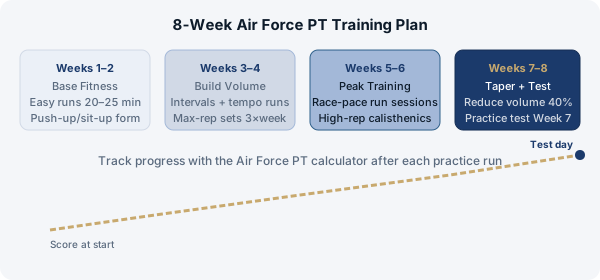
For a complete training plan integrating run work with calisthenics, see the 8-week Air Force PT improvement program. It has the week-by-week schedule that ties run intervals to your push-up and sit-up work.
Want to see what run time you need to hit a specific score? Use the fitness score calculator and work backward from your target composite.
For more on how this site validates its scoring against current DAFMAN 36-2905 tables, visit the about page.