Staying Air Force PT Ready Year-Round: Training Strategies
Air Force fitness testing runs on a cycle, not a one-time event. These year-round training strategies keep your PT score test-ready without burning out between assessments.
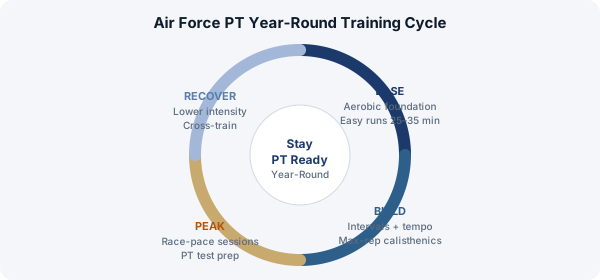
The testing cycle is annual, but fitness doesn't work on a schedule. Airmen who train only in the weeks before their assessment consistently score lower than those who maintain a base level of fitness year-round, and they accumulate a much harder hole to climb out of each cycle.
Here's how to structure your training through the full year, not just the 8 weeks before a test.
Why Year-Round Training Matters
There's a common mental model among Airmen: the test is once a year, so training hard for 6–8 weeks beforehand is enough. That model breaks down in a few ways.
First, aerobic fitness, the component that earns 60% of the AFPT composite, requires sustained effort to build and only takes a few weeks of inactivity to meaningfully decline. A male Airman who posts a 12:00 run time in April may find his comfortable pace has drifted to 13:30 by October if he stops running. Getting back to 12:00 from 13:30 takes 6–8 weeks of consistent work. That barely fits in a prep window.
Second, calisthenics strength-endurance degrades more slowly than aerobic fitness but still requires maintenance. Three months without push-up training typically costs 20–30% of peak performance.
Third, testing cycles aren't always predictable. Deployments, TDYs, and administrative scheduling changes can shift your assessment window. Airmen who stay near test-ready don't get caught off guard.
Periodization: A Simple Framework
Periodization means organizing training into phases with different goals. It doesn't require a complex plan, just three phases that shift emphasis across the year.
Base Phase (months 1–4 after your last assessment): Focus on consistent volume at moderate intensity. Run 3–4 days per week at a conversational pace, enough to maintain your aerobic base without high-intensity stress. Do push-up and sit-up maintenance sets 2–3 times per week, staying well short of failure. The goal is to not lose ground.
Build Phase (months 5–8 after your last assessment): Increase run frequency to 4–5 days per week. Add one interval session per week, such as 6 × 400 meters at goal pace, or 3 × 800 meters at threshold pace. Increase push-up and sit-up frequency to 3–4 days per week, pushing closer to your working maximum. The goal is measurable improvement.
Peak Phase (final 8 weeks before assessment): Targeted test prep. Run 5 days per week including 2 quality sessions (intervals and a tempo run). Do timed push-up and sit-up practice under test conditions 3 times per week. Use the Air Force PT score calculator weekly to track your projected composite based on practice results. Taper in the final week.
The phases don't have to be exactly this length. What matters is that you're not spending 12 months either grinding at peak intensity (recipe for injury and burnout) or coasting (recipe for a stressful prep window).
Maintaining Run Fitness Without Overtraining
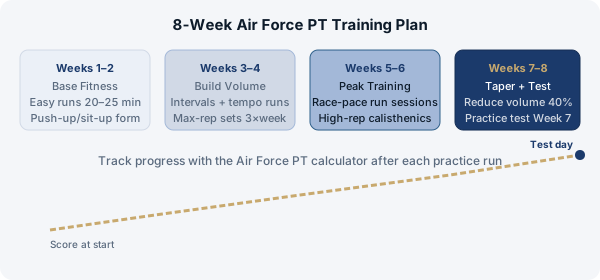
The run is worth 60 points. It's also the component most susceptible to overuse injuries when volume spikes rapidly before a test.
The sustainable maintenance approach: 3 runs per week at easy to moderate pace, averaging 15–20 miles per month. That's roughly 5–7 miles per week, enough to maintain a solid aerobic base without accumulated stress from heavy mileage. One of those three runs can be slightly longer (4–5 miles); the other two can be shorter (2–3 miles each).
Never increase weekly mileage by more than 10% from one week to the next. This is the most well-supported principle in endurance training for injury prevention. An Airman who runs 15 miles in week 1 of prep and 30 miles in week 3 is setting up a stress injury before the test.
Strength training for the legs (squats, lunges, single-leg deadlifts) supports run performance by reducing fatigue per stride. Two days per week of lower body strength work in the base and build phases pays dividends when interval intensity increases in the peak phase.
Seasonal Adjustments
Summer (June–August): Heat slows run times measurably. Don't adjust pace targets without adjusting for conditions. A 12:30 run in 90°F heat may reflect better fitness than a 12:00 run at 60°F. Move outdoor runs to early morning before heat peaks. Hydration increases: add 8–16 oz of fluid per hour in hot conditions. Treadmill training with a 1% incline replicates outdoor running resistance when conditions are extreme.
Winter (December–February): Cold requires longer warm-ups, at least 10 minutes of easy movement before any quality effort. Dry cold air can trigger respiratory symptoms in some runners; a buff or gaiter over the mouth helps. Indoor alternatives (treadmill, stationary bike, rowing machine) maintain aerobic base when outdoor conditions are genuinely unsafe.
Spring and Fall: The best training conditions for most of the country. Use these seasons for quality sessions like intervals, tempo runs, and push-up and sit-up maxing, when you can perform without environmental drag.
Gym vs. Outdoor Training Split
Both have real advantages. The optimal approach uses both.
Outdoor running builds the sport-specific fitness the test measures. The 1.5-mile test happens outdoors on a track or road course in most units. Training on similar surfaces trains the specific movement patterns you'll use on test day.
Gym training enables controlled strength work, weather-independent sessions, and injury prevention exercises (hip flexor strengthening, glute activation, core stability) that transfer directly to better push-up and sit-up performance. A basic split during the build phase might look like: Monday (outdoor run + push-up and sit-up work), Wednesday (gym strength + treadmill interval), Friday (outdoor run), Saturday (long easy outdoor run).
Don't treat gym versus outdoor as either-or. The Airmen with the highest composite scores typically run outside for quality sessions and use the gym for strength work and weather alternatives.
Setting Quarterly Score Targets
One of the most practical year-round habits: set a score target for each quarter and check yourself against it using practice assessments.
An example target progression for an Airman with an October assessment:
- January: 78 composite (maintaining, not peaking)
- April: 82 composite (build phase gains taking hold)
- July: 85 composite (approaching peak fitness)
- October test: 88 or better (full peak performance)
Run practice numbers through the AFPT composite score tool at each checkpoint. If you're at 74 in April when you expected 82, you have 6 months to fix the problem, not 6 weeks. If you're at 85 in July, you know the peak phase only needs to close a small gap.
This approach removes the anxiety of not knowing where you stand. It converts a vague annual obligation into a tracked, progressive goal with clear feedback at each stage.
Eating and Recovery Habits That Support Maintained Fitness
Nutrition doesn't need to be complicated for fitness maintenance. A few consistent habits carry most of the weight.
Protein consistency: 0.7–1.0 grams of protein per pound of bodyweight per day supports muscle maintenance and recovery. For a 175-lb Airman, that's 120–175 grams per day. Spread across 3–4 meals, that's achievable without supplements.
Sleep as recovery: Muscular repair and aerobic adaptation happen primarily during sleep. 7–9 hours nightly isn't optional for athletes. It's when the training actually takes effect. Airmen who consistently sleep 6 hours will plateau faster than those sleeping 8, regardless of training quality.
Active recovery: On rest days, 20–30 minutes of walking or light movement maintains circulation, reduces soreness, and supports the next day's performance. Complete inactivity on rest days often leads to more stiffness than light movement does.
Fitting PT Into a Busy Schedule
The realistic constraint for most Airmen is time. Shift work, ops tempo, family obligations, and professional development requirements all compete with training time.
The minimum effective dose for year-round fitness maintenance is roughly 4 hours per week: 3 runs of 20–30 minutes, 2 calisthenics sessions of 15–20 minutes, and 1 strength session of 30 minutes. Four hours across 7 days. Most schedules can accommodate this if it's treated as a non-negotiable calendar block rather than a discretionary activity.
Morning training removes the scheduling conflicts that come with after-work plans, late meetings, and family events. Airmen who train at the same time each day build a habit that requires less decision-making and produces fewer missed sessions.
When time is genuinely tight, prioritize in this order: run first (most points, most degradation-prone), push-ups second, sit-ups last (most forgiving of short-term detraining). A 20-minute run beats no training. A 10-minute push-up session beats skipping calisthenics entirely.
For a structured plan when you need to raise a specific score before an upcoming test, the 8-week PT score improvement guide covers progressive programming in detail. For run-specific technique and interval structure, the Air Force run improvement guide has everything needed to move a slow 1.5-mile time.
The Airmen who consistently score 85 and above aren't training harder than everyone else. They're training more consistently, more specifically, and more strategically across the full year. Four hours a week and a quarterly check-in is the whole system.
For more on how this site's scoring reflects current DAFMAN 36-2905 tables, see the about page.